EFA's History: Volunteers Made It Happen
By Martin Kohl
The Editorial Freelancers Association can trace its origins to 1970, when editors at Grove Press went on strike in an effort to make the publishing industry more responsive to their needs. During the course of events, two Grove editors who found themselves freelancing again—Mary Heathcote and Cicely Nichols—met with freelancers Faith Sale, Louise Stallard, and Margaret Wolf to discuss the situation, and predicaments, of freelancers.

Gradually, as the discussions became more general, other freelancers—friends and colleagues—began attending. At first the meetings were held in members' apartments, but in time attendance grew enough to require larger meeting places. Around this time there were disagreements about whether or not the emerging organization should be politically oriented, but eventually an apolitical professional association, the Editorial Freelancers Association (EFA), was formed.
According to former co-executive and later treasurer Trumbull Rogers, EFA "provides services to members and also a place to come together for social networking. That was one of the precepts on which we were incorporated."
Early Meetings
By 1976 EFA had 100 members and was holding its general meetings in a school cafeteria in New York City's Greenwich Village. The leadership group, called the Planning Committee, was concerned primarily with increasing membership, providing benefits, and meeting EFA's financial needs. The organization also produced a rudimentary membership directory and a monthly newsletter.
During the late 1970s EFA continued to grow steadily. It became clear that a more formal structure was needed. Organizing that structure took two years. A Structure Committee wrote bylaws and created the Board of Governors, which was to be headed by two co-executives, one female and the other male. It also created the positions of secretary and treasurer. Charles Carmony, an indexer, and Elaine Chubb, a copy editor, were the first two co-executives.
By holding general meetings in a variety of places, such as the Carnegie Center, the Women's City Club, and the Stephen Wise Free Synagogue, and using a mail drop and answering service in the Flatiron Building at 175 Fifth Avenue, EFA was able to increase its membership to the point where enough revenue was available to rent an office. Finding an office had become a top priority: EFA needed a place to keep membership records and receive mail.
Our Own Office at Last
In 1979, EFA opened its first office, a small, dark space in a funky building on East 20th Street in Manhattan. It was furnished with a combination of luck and charity. "We found some furniture in the office we moved into, and some came from a vacant office across the hall. The landlord told us to help ourselves. We also found some of it in the street," says Rogers. EFA now had somewhere to offer courses, hold Board and committee meetings, and keep its records.
Within a few years the organization outgrew the 20th Street office and moved to bigger and brighter quarters—with more reliable heat and adequate wiring for air conditioning—on East 23rd Street. With the move came a new computer system and a more professional approach to office management. The new space was large enough to hold twenty to thirty people comfortably, allowing EFA to hold courses and affinity group meetings without having to arrange for outside space. However, general meetings continued to be held in more ample spaces like the nearby Women's City Club.
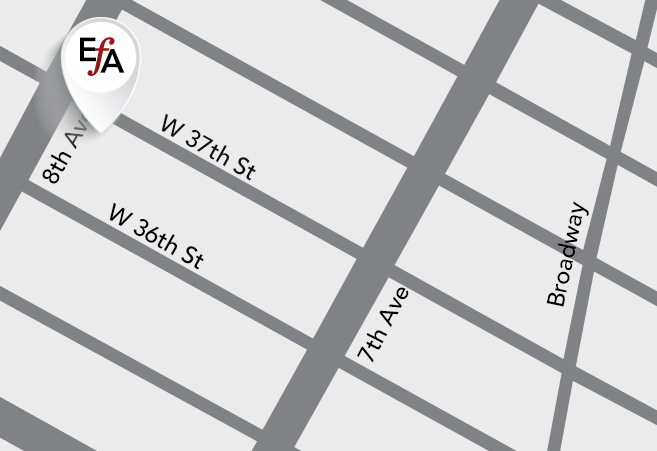
Even though EFA is still using some of the same furniture that was scrounged for its first office—in particular, a massive mahogany partners' desk that is very hard to move—the association's current headquarters on West 23rd Street is indicative of how far it has come. The offices consist of a spacious central area for general meetings and three smaller rooms housing the business office, a library, and committee files and mail bins.
Hiring Some Help
In 1985 came the novel (for EFA) idea of hiring an office manager to answer the phone, deal with the mail, and handle the variety of chores required by a professional organization. But even more important were innovations that came from volunteers.
Job Phone
The first, the Job Phone, was modeled after a similar service run by Washington Independent Writers (WIW). But instead of charging a percentage from each job a freelancer got from the service, as WIW and other groups do, EFA decided to charge subscribers a flat, one-time fee of $10, which can usually be earned back in the first hour of an assignment. The Job Phone's founder, Trumbull Rogers, suggested the idea to the Board of Governors, then set up the service and ran it from October 1981 until June 1988, by which time there were nearly 400 subscribers. (Today, the annual fee to members is $40, and the Job List is administered through e-mail.)
Although the availability of work is obviously vital for freelancers, knowing what the market wants is equally important.
Affinity Groups
Affinity groups for members working in such fields as medical editing, computers, textbooks, desktop publishing, and public relations were begun in 1989, when medical writer and former Program Committee chair Walter Alexander began the first such group, for nonfiction magazine writers. Meeting about once a month, each affinity group features speakers discussing topics ranging from what kind of ideas a magazine might be looking for to the latest computer software for indexers. The value of having an editor or a director of communications discuss a company's editorial needs is inestimable, as is the ability to question that person more closely after the presentation.
Affinity groups for new freelancers (who may in fact already have many years of editorial experience) provide the neophyte independent contractor with the basic skills and knowledge that can make the difference between success and failure. "I think it's a really important part of the experience for a lot of people and it's unleashed a lot of creativity. In the past few years, affinity groups have been a major factor in our growth and provided an impetus for moving to our new offices," then Program Committee chair Sheila Buff commented.
Regional Chapters
Regional chapter development was initiated in 1997 to enrich the EFA experience for members outside the New York headquarters area. The first EFA regional chapter, EFA Mid-Hudson Valley in upstate New York, had its inaugural meeting on March 20, 1999 in Red Hook, NY.
All of the innovations, leadership, and plain hard work that have kept EFA growing for the last thirty years came from volunteers. Some freelanced for a while and went back to full-time positions; others continued freelancing on a permanent basis. As Rogers points out, the freelance life doesn't suit everyone: some people prefer the structured environment of an office, or can't deal with the uncertainties of freelancing. But whatever their preference, the freelancers in EFA have always managed to find time for their organization. "A core group of about fifty or sixty volunteers year after year were the ones you could count on to really pull the weight and do the work and keep the organization running and growing."
EFA was a pioneer in organizing freelancers into a network for mutual support and advancement. Today it is recognized throughout the publishing industry as the source for professional editorial assistance. And as editorial freelancing—indeed, freelancing in many fields of endeavor—becomes more prevalent, EFA can look forward to an even brighter future.
[ back to top ]